
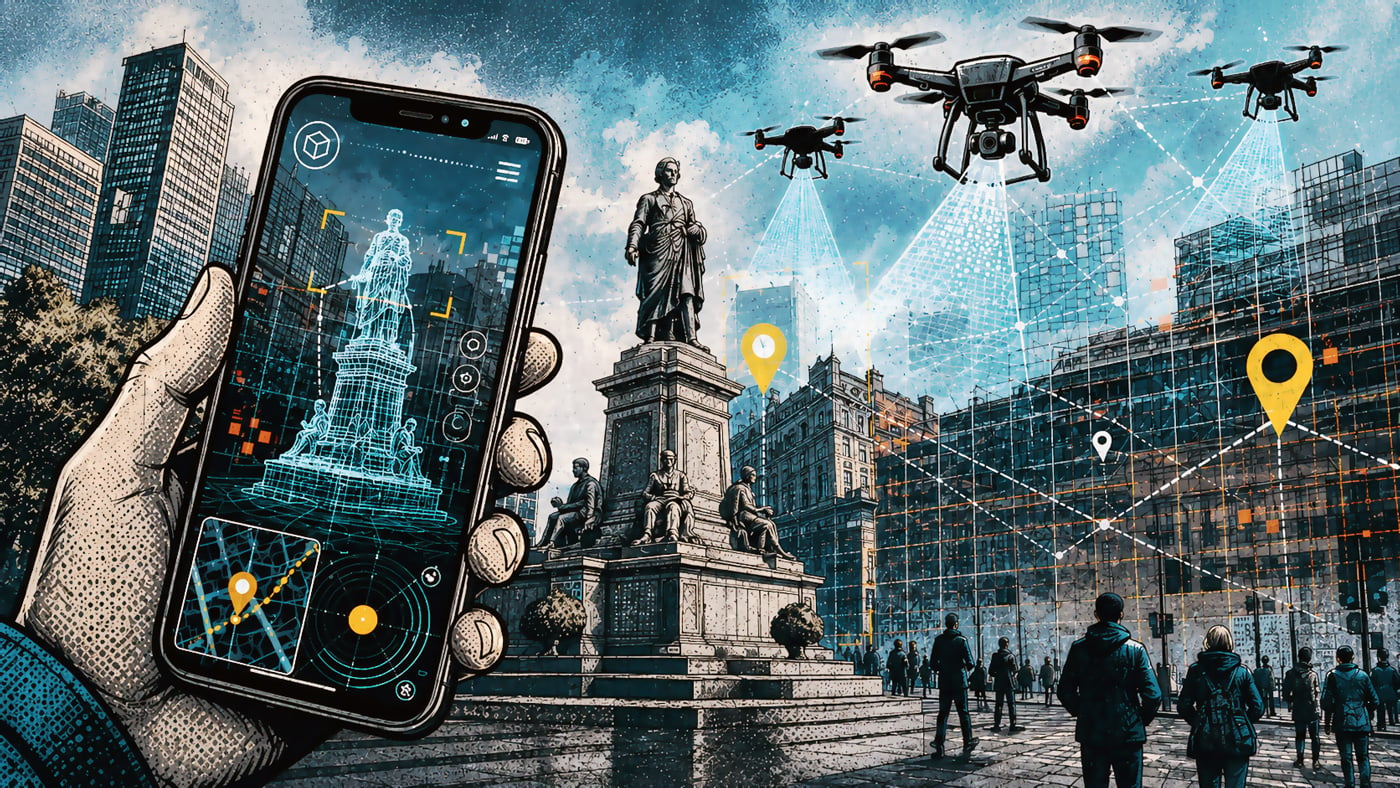

Reports from Dutch newspaper Trouw and subsequent coverage from drone and technology outlets have raised questions about whether data gathered through Pokémon GO’s optional AR scanning feature helped train technology that could now be relevant to drone navigation, including military and defense use cases.
The concern is not that Pokémon GO itself is controlling drones, or that your regular gameplay route is being sent to a battlefield. The concern is a bit more complicated:
- Niantic has always collected spatial data from the scan a PokéStop or Gym research tasks…
- …but they relatively recently confirmed that player-contributed scans helped them build a large spatial AI model…
- …which is now being used by Vantor, a defense company working on air-to-ground positioning systems for GPS-denied environments, which Niantic Spatial has since partnered with
Niantic Spatial has pushed back on the most direct version of the claim that implies that actual player scans are being used for drone targeting purposes.
In comments reported by IGN, the company insists that Pokémon GO data is not being used to train military drones. The company says AR scans were submitted voluntarily by players who opted into the feature, and that Pokémon GO scan data is not being provided to Vantor as part of the partnership.
Even with that clarification, the story raises a serious question for Pokémon GO players: when a game asks you to scan the real world for rewards, what exactly are you helping to build?
Make sure to watch the attached videos to this article for a better understanding what the technology developed by Niantic Spatial and Vantor can produce.
 Don’t confuse Scopely with old Niantic or Niantic Spatial
Before we start this article, we want to emphasize that Scopely, the company that owns and operates Pokémon GO, has no affiliation with Niantic Spatial. Niantic Spatial is a spin-off company that was created after Scopely acquired Pokémon GO in 2025.
Niantic, the company that used to own and operate Pokémon GO, is no longer associated with the game. The entire staff that was working on Pokémon GO was bought and moved over to Scopely during the sale.
Today’s article only focuses on Niantic Spatial, the spin-off company that is selling AR scanning data that was collected through Pokémon GO, alongside specialized AI models focused on real world navigation without GPS. We have already written about these models in 2025, but those article did not get much traction at the time: Niantic announces “Large Geospatial Model” trained on Pokémon GO player data. Maybe to day is the time to revisit those articles.
Scan that PokéStop, here’s a Poffin!
Pokémon GO’s AR scanning feature asks players to record short scans of real-world locations, usually PokéStops or Gyms. These are not passive scans created simply by walking around and catching Pokémon, you have to actively choose to scan a public location, move around it with your phone camera, and upload the scan.

The scans include visual information, position, angle, and real-world context that help software understand how a physical place is shaped. When collected at scale, these scans become useful for building a visual positioning system, or VPS.
A VPS helps a device understand where it is by comparing what its camera sees with a previously mapped version of the real world.
Unlike GPS, which relies on satellite signals, visual positioning can work by recognizing buildings, walls, signs, paths, sculptures, entrances, and other visible landmarks. VPS is at the very core of this story: when you submit AR scans, you are contributing to a machine-readable understanding of real-world spaces.
Niantic was very proud about this technology back in the day, and they are still actively developing it:
Although Niantic described this feature as optional, the fact is that Poffins were always a worthy reward for walking around and scanning, even after Niantic banned just holding your phone down and scanning the ground.
Niantic Spatial’s Large Geospatial Model
Niantic Spatial, the company spun out of Niantic after its games business was sold to Scopely, is now focused on geospatial AI. Its central project is a Large Geospatial Model, or LGM, build directly from player scans.
The easiest way to understand an LGM is to compare it to a Large Language Model. A language model learns patterns in text. A geospatial model learns patterns in physical space. Instead of predicting words, it helps machines understand places: where objects are, how streets and buildings relate to one another, what a location looks like from different angles, and how a camera can determine its position in the real world.
Niantic has openly said that player-contributed scans of public real-world locations helped build this model. It has also said the scanning feature is optional and that people must intentionally visit a location and choose to scan it.
Niantic can say that players opted in, that scans were submitted voluntarily, and that normal gameplay is not training an AI model. Critics can say that most players likely did not understand the long-term commercial, industrial, or defense-adjacent implications of submitting scans for in-game rewards.
But both things can be true at the same time. But it is important to understand that there is an AI model which was built using just the AR scanning data. And Vantor has access to this model, just like many other companies which are paying for Niantic Spatial services.
Who is Vantor, and why are they important?
Vantor describes itself as a spatial intelligence company, and its work includes defense and intelligence applications. In December 2025, Vantor announced a partnership with Niantic Spatial to create a unified air-to-ground positioning system for GPS-denied areas.
“GPS-denied” means environments where GPS is unavailable, unreliable, jammed, spoofed, or blocked. That can happen in dense cities, indoors, underground, in disaster zones, and in military environments where electronic warfare is used to disrupt satellite navigation.
According to Vantor’s announcement, the partnership combines Niantic Spatial’s ground-based visual positioning technology with Vantor’s aerial positioning software. The stated goal is to let drones, vehicles, AR glasses, and other field assets share a coordinate system even when GPS is not available.
One common area which is “GPS-denied” are warzones, like Ukraine, where drones reign supreme on the battlefield.
Is Vantor using Niantic’s model, and by extension, player submitted data?
The key question is not whether Vantor has a folder full of raw Pokémon GO AR scans, they don’t have that and Niantic Spatial says it does not.
The more serious question is whether Vantor is benefiting from Niantic Spatial technology that was made possible, in part, by years of player-submitted scans.
On that point, the answer is harder to dismiss:
- Niantic Spatial’s own materials describe its spatial AI and visual positioning systems as products of large-scale real-world mapping,
- while the Vantor partnership explicitly applies that technology to GPS-denied positioning for drones, vehicles, AR glasses, and other field assets.
It would be foolish to assume that a paying Niantic Spatial customer is not using the tech they are paying for. Are they using it for military drones? No one will confirm or deny that, but the whole world is using drones for various purposes and you can draw your own conclusion from there.
Is Niantic still collecting data from the game?
As far as we know, no, not anymore.
“Now as part of Scopely, Pokémon Go data is not shared with Niantic Spatial,” a spokesperson said. “AR Scans collected through Pokémon Go were submitted voluntarily by players who opted into the feature and were subject to the applicable Terms of Service and Privacy Policy at the time. The discontinuation of AR scanning and the end of data sharing with Niantic Spatial were part of the transition planning associated with Pokémon Go’s move to Scopely.”
What should Pokémon GO players take away?
The first takeaway is that normal Pokémon GO gameplay is not the same as AR scanning. Walking around, catching Pokémon, raiding, battling, trading, and spinning PokéStops is not dangerous and you are not helping train drones.
The second takeaway is that AR scanning is different. If you choose to scan a PokéStop or Gym, you are contributing visual data about a real-world location.
The third takeaway is that the most dramatic claims should be handled carefully. Based on Niantic Spatial’s response, it is not accurate to state as fact that Pokémon GO data is currently being used to train military drones.
It is more accurate to say that Pokémon GO scan data helped build Niantic’s spatial AI technology, and that Niantic Spatial is now working with Vantor on positioning technology with drone and defense-relevant applications.
That distinction will definitely not satisfy everyone, but it is important to understand.